Contact Us
Nationwide Support
Our team of air quality experts is specially trained to understand the unique challenges of each region across the United States.
Connect with an expert!
Contact Your Region's Representative
West of Texas
Matt Graham
East of Texas
Aiman Barakat

Reduce Airborne Exposure
The Alen Partnership Program uses high capacity medical-grade HEPA filtration. By continuously removing fine particles from the air, organizations can reduce airborne exposure risks and support healthier spaces for everyone.

Streamline Operations
Easily manage devices and filter maintenance through a centralized system. Teams can track performance, schedule filter changes, and maintain reliable air purification without complicated workflows or manual oversight.

Simplify Procurement
Find budget efficiencies with an easy procurement process, reduce costs with fewer changeouts, and improve efficiency with better data.
Knowledge Center
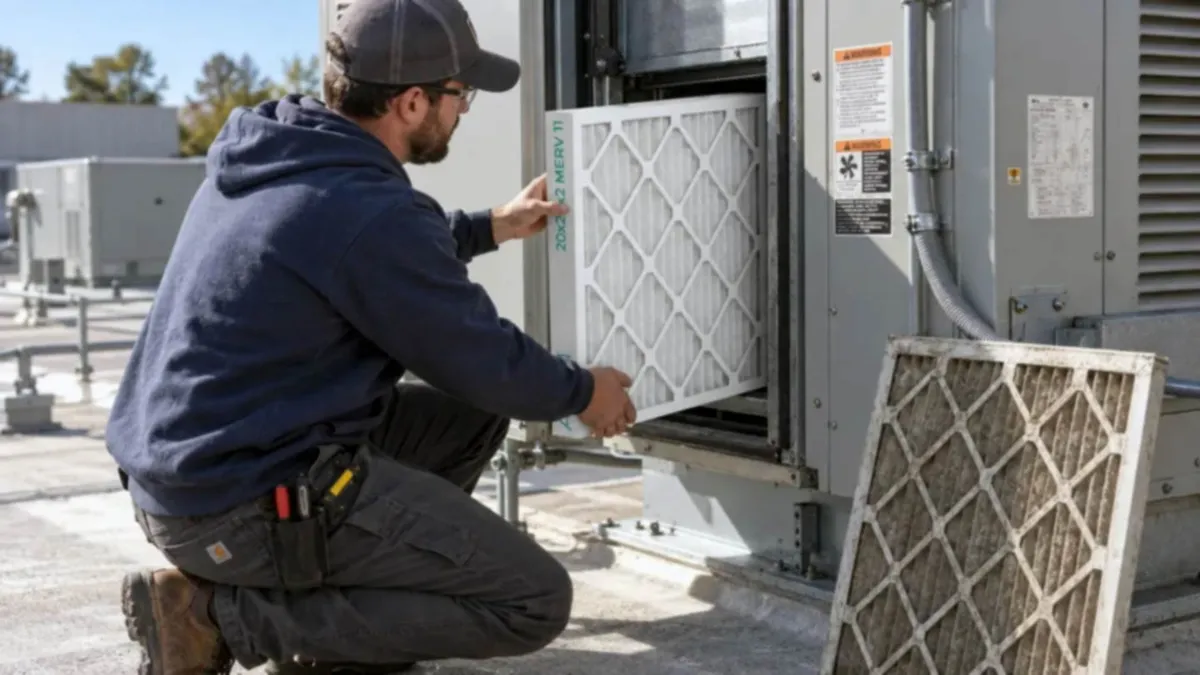
5 Ways High-Capacity Filters Can Save Your School District Money
When you’re buying HVAC filters for an entire school district, unit price matters. Even a small difference can add up across hundreds or thousands of filters. But the price you pay for each filter is only part of what your filtration program costs over time.
High-capacity filters are designed to hold more particles and support a longer service life when properly specified. That can mean fewer filters to purchase, store, replace, and dispose of throughout your district.
For your facilities and procurement teams, those efficiencies can translate into meaningful savings. Here are five ways high-capacity filters can help your district make its filtration budget go further.
What You Need to Know
Longer filter life can reduce the number of filters your district purchases each year.
Fewer replacements can simplify inventory, ordering, deliveries, and maintenance planning.
Compare annual material spending and maintenance work using your district’s filter prices and achievable service intervals.
1. Buy Fewer Filters Over the Course of the Year
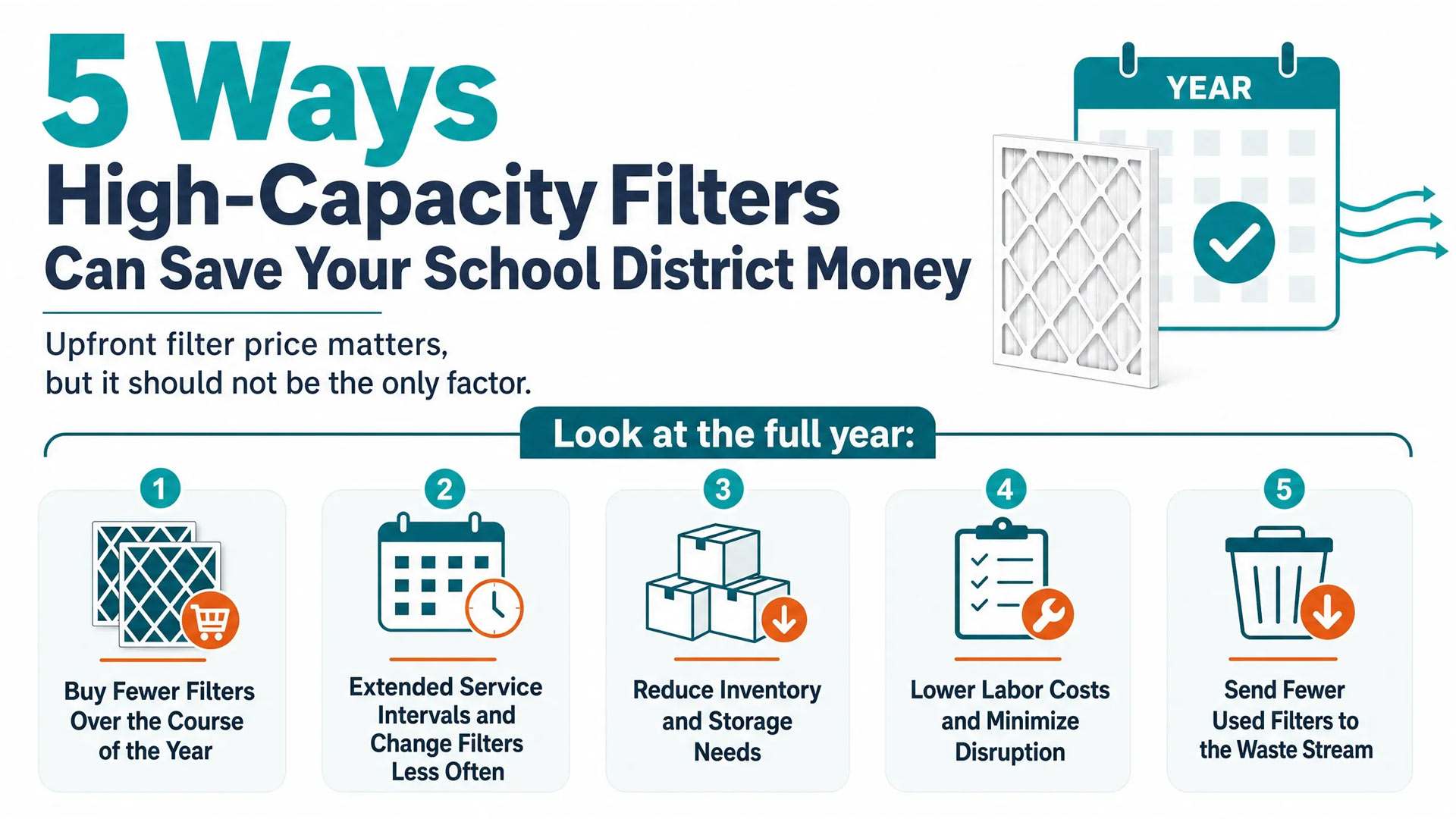
The most direct opportunity is also the simplest: a filter that remains in service longer does not need to be purchased as often.
For a single HVAC unit, that difference may seem small. Across a district with multiple schools and hundreds or thousands of filter positions, it can become much more meaningful.
That is why purchase price should be considered alongside expected service life. A higher price per filter can be offset by buying fewer filters over the year. Compare both the quoted prices and the replacement intervals your buildings can support.
The more useful question becomes: How many filters will we need to buy to support this building for a full year?
2. Have Less Inventory Moving Through Your District
Every filter your district purchases has to go somewhere.
It may need to be received at a central warehouse, sorted by size, stored, distributed to individual campuses, or kept on-site until the next scheduled replacement.
When filters last longer, fewer replacements need to move through that process.
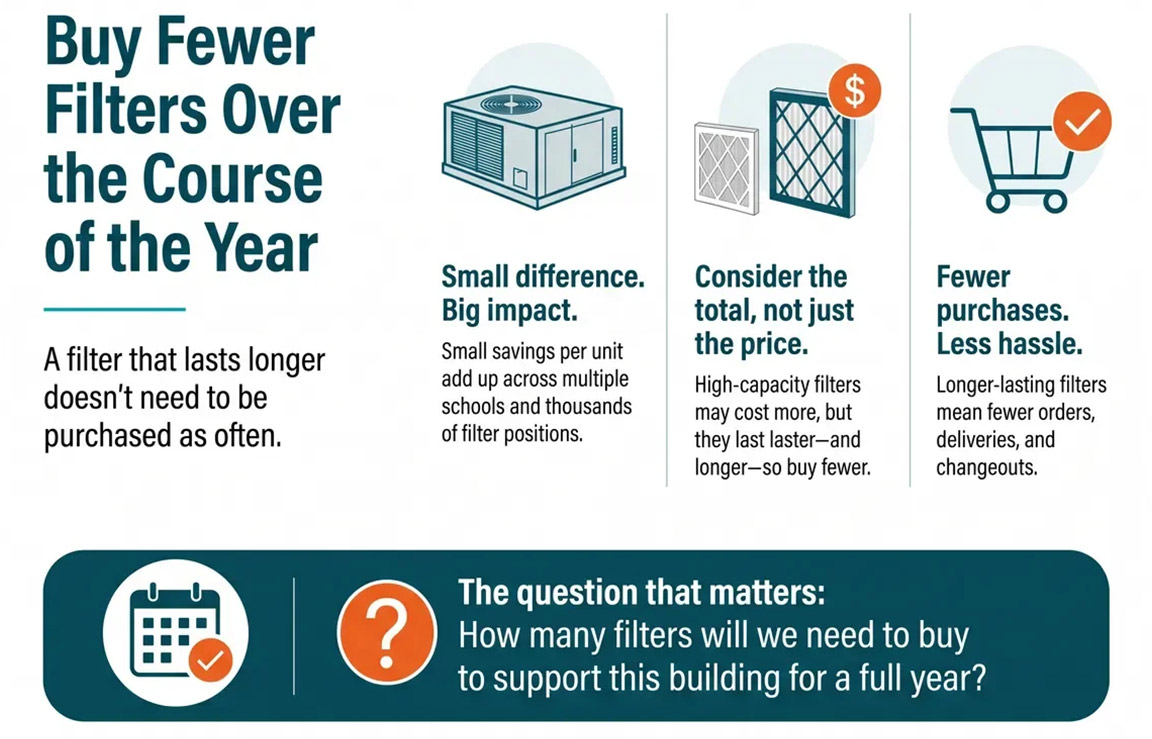
That can simplify inventory management, particularly if you’re managing different filter dimensions and HVAC configurations across multiple buildings.
Your facilities team still needs the right filters available when they are needed. High-capacity filtration can reduce the volume of replacement inventory that has to be purchased, stored, moved, and managed throughout the year.
3. Reduce the Purchasing Work Behind Every Filter
The work behind a filter order extends beyond the products on the invoice.
Someone has to determine quantities, coordinate with vendors, receive deliveries, reconcile invoices, update inventory, and make sure the correct filters reach the correct buildings. Vendor reliability and service support influence how smoothly that process runs.
Reducing annual filter volume means fewer individual filters moving through that process. In our illustrative 30-school model, moving from four change cycles per year to two reduces annual filter use from 9,360 to 4,680 filters. That is 4,680 fewer filters to purchase, receive, stock, distribute, and ultimately dispose of.
The number of purchase orders or deliveries will depend on how your district buys. But when purchases and shipments can be consolidated, a lower annual filter requirement can also reduce the transaction work surrounding the program.
4. Give Your Facilities Team More Flexibility
Across a school district, filter changes compete with preventive maintenance, equipment issues, and other building needs. Longer service intervals can give facilities teams more room to focus on those priorities.
In our illustrative 30-school model, moving from four filter-change cycles to two reduces modeled filter-change labor from 1,560 to 780 hours per year. With 60% of units assumed to require roof or ladder access, annual access visits also fall from 2,808 to 1,404.
Those hours do not necessarily translate directly into payroll savings. The bigger benefit may be more staff capacity for maintenance, repairs, and other facilities work, with direct savings possible where overtime or contracted service is reduced.
That’s about half the length and keeps the strongest numbers.
5. Every replacement creates a used filter that must be removed, handled, and discarded.
Extending useful filter life can reduce the number of filters your district goes through annually. In addition to lowering purchasing volume, that means fewer used filters need to be collected and disposed of.
In the same illustrative 30-school model, reducing annual change cycles from four to two avoids 4,680 filter replacements per year. At the model's one-pound average filter weight, that represents about 2.34 tons of filter material that does not enter the waste stream annually. Actual waste reduction will vary with filter size, construction, and weight.
Fewer change cycles may also mean fewer maintenance trips between facilities. The model allows districts to enter their own route mileage, fleet efficiency, and filter weight so these operational and environmental effects can be evaluated using local assumptions.
If you're managing filtration across many campuses, reducing material consumption is another way to get more value from every filter purchased.
Think in Terms of Value Per Year
When comparing HVAC filters, upfront price is useful information. But it should not be the deciding factor.
Consider the full year:
How many filters will your district purchase, and at what price?
How often will they need attention?
How much inventory will move through your facilities operation?
How much routine work will your team need to coordinate?
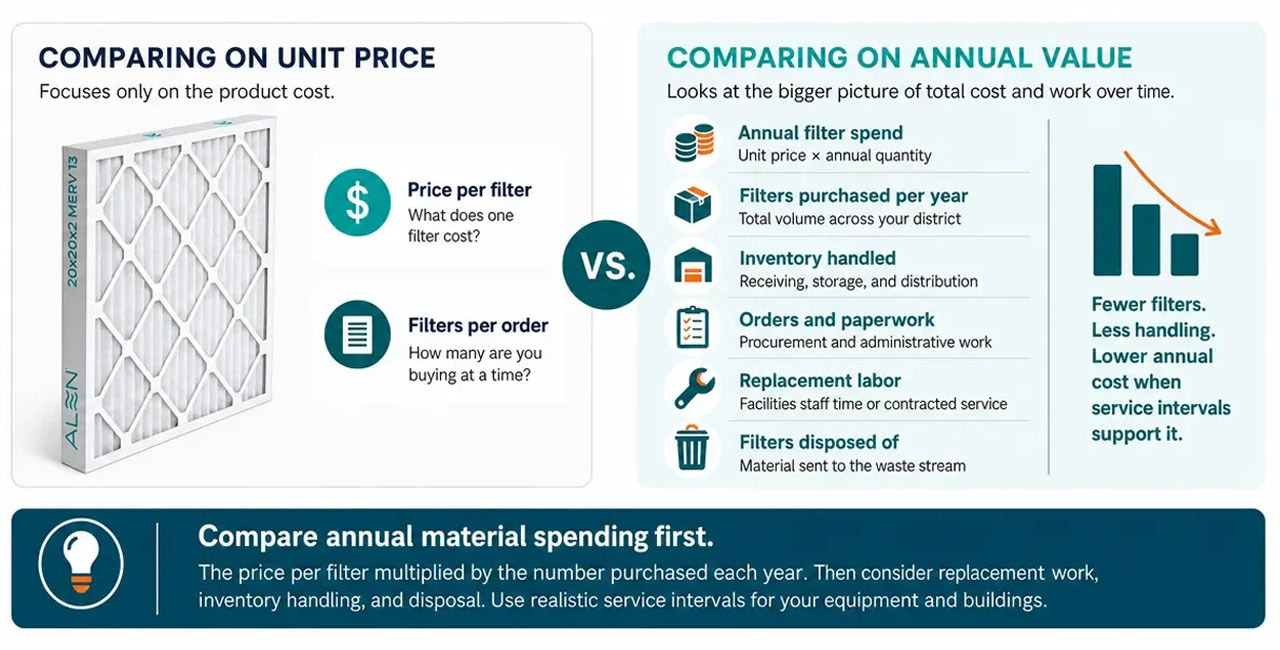
Compare annual material spending first: the price per filter multiplied by the number purchased each year. Then consider replacement work, inventory handling, and disposal. Use realistic service intervals for your equipment and buildings.
For a broader view that adds labor, risk, and operating assumptions, explore our HVAC financial model for schools, including detailed breakdowns for small, medium and large school districts. These are illustrative models; actual savings depend on your district’s pricing, staffing, access conditions, and achievable service intervals.
Plan an Extended-Life Filter Program With Alen For Business
At Alen For Business, we help school districts build filtration programs around the needs of their buildings, equipment, facilities teams, and budgets. With high-capacity HVAC filtration available in MERV 8, MERV 11, and MERV 13 options, along with custom sizes and configurations, we can help you find the right fit across diverse school facilities.
Ready to compare your current program with an extended-life filter strategy? Start with our filter material savings calculator for a direct material-and-waste comparison built around a 2x/year target. For a broader operating-cost view, use the HVAC financial model for schools. Then contact us to evaluate your actual pricing, equipment, staffing, and service intervals.


Proactive Health Leadership
Move from reactive air management to proactive health leadership. Air quality monitoring (AQM), airID technology, and environmental sensors provide real-time awareness of indoor air conditions. Insights that allow you to identify issues early and optimize air performance.

Build Trust
Transparent air performance and solid sustainability practices builds confidence with employees, customers, and stakeholders.
Request a Consultation
Get a personalized and detailed assessment of your school district's needs, and how Alen For Business can help save you money and streamline your operations.

Online & Phone Operating Hours
Mon to Fri: 8AM–5PM CST
The Program
About Us
Online & Phone Operating Hours
Mon to Fri: 8AM–5PM CST