The Real Cost
HVAC Filter
Programs for
School Districts
Are you still assessing your HVAC filters by unit price? On paper, it’s straightforward and controllable. The filter becomes a line item and then it’s a procurement decision.
But when you step back and evaluate the full operational impact of your filter program, the numbers tell a much different story.
The overall system drives the true cost, not the actual filter. Labor hours, rooftop exposure, safety risk, overtime, and workflow disruption compound with every changeout cycle. Frequency, not filter price, ultimately shapes the total cost.
That’s why Alen For Business works so well. Unlike a traditional system, our program combines extended-life filtration, air purifiers, and air quality monitoring to create a dynamic, data-driven ecosystem. The outcome: lower annual expenses, reduced labor and risk exposure, minimal classroom disruption, and stronger sustainability metrics.
Benefits Snapshot:
Advanced, smart filtration: Extended-life filtration involves high-capacity HVAC filters, classroom air purifiers, and air quality monitoring with minimal classroom disruption.
Savings: switching to an extended-life filtration program saves school districts tens of thousands of dollars yearly in reduced risk and labor costs.
Sustainability: reducing filter changes by half allows school districts to greater protect the environment by reducing greenhouse gasses and avoiding thousands of wasted filters and tons of land
Alen partners with school districts to deliver an extended-life filter strategy with a three-pronged approach: high-capacity HVAC filtration, air purification in classrooms, and air quality monitoring.
This strategy benefits your district with lower annual expenses, reduced labor and risk exposure, minimal classroom disruption, and stronger sustainability metrics.
It’s Not About Unit Cost, It’s Frequency
When evaluating filter programs, avoid solely focusing on the unit cost. The true operational lever is frequency. Every scheduled changeout triggers a series of actions that can create disruption and add cost, risk, and time:
Class or campus disruptions. Routine maintenance can interrupt class instruction or campus activities.
Technicians travel between sites. Each service cycle requires routing, dispatch coordination, vehicle use, and transit time involving scheduling inefficiencies, fuel costs, and vehicle wear.
Ladder climbs and elevated work. Accessing rooftops increase cumulative exposure to slips and falls, requiring time and safety checks. Unlocking roof hatches, staging tools, securing work areas, and complying with access protocols add time and risk.
Lift staging and operation. Technicians can use lifts or specialized access equipment that require transporting, positioning, and operating machinery safely.
Safety protocol activation and documentation. Elevated work often requires labor-intensive fall protection procedures, safety checklists, and documentation.
Work order processing and administrative tracking. Behind every physical service task are time-consuming administrative tasks.
So, how do you address these challenges? It’s actually simple: swap your quarterly filter changeouts with an extended-life system. Two instead of four changeouts annually allows for savings, reduced classroom disruption, and positive environmental impact.
Quarterly Changeouts Costs Add Up
Change can be stressful, so let’s look at the data. Labor models of quarterly changeouts across an entire district tell a convincing story. The total annual labor and material cost for quarterly changeouts adds up. And that doesn’t account for other “hidden” expenses, such as expected claims cost and workman’s compensation premiums.
For illustrative purposes, let’s look at the following scenario.
Baseline Assumptions
- 30-school district
- Labor cost: $35/hour
- Time per filter (fully loaded): 10 minutes
- Cycles: 4/year (baseline) vs. 2/year (extended-life)
- Filter cost: $3.50 per filter
Labor Cost
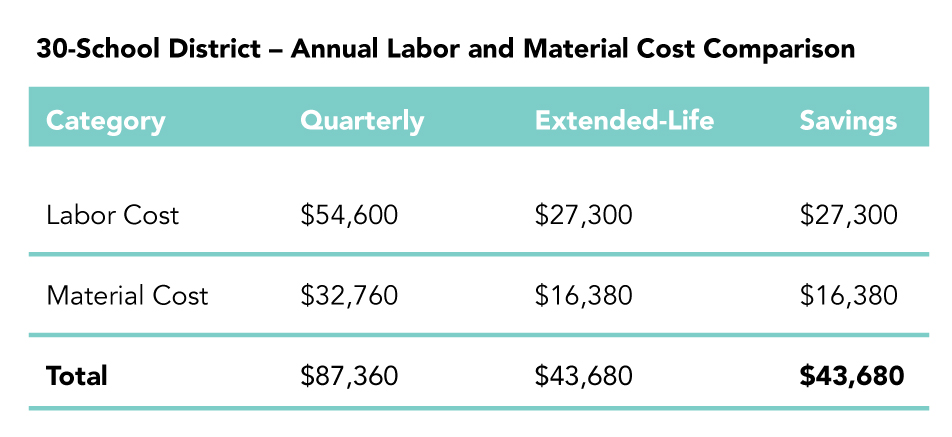
In this scenario, switching from quarterly to extended-life changeouts reduces the annual labor cost by 50%: from $54,600 to $27,300. Instead of hiring more staff or paying overtime, facilities teams can use this time to stay ahead of seasonal demands and unexpected issues: preventive maintenance inspections, airflow balancing, controls calibration, and mechanical issue fixes.
Material Cost
Switching from quarterly to extended-life changeouts is another source of savings: $16,380 in this scenario as the cost is reduced from $32,760 to $16,380.
Total Labor and Material Cost Savings
Taken together, the total annual cost in this scenario decreases from $87,360 to $43,680, a savings of $43,680. Over four years that savings is about $175,000. And this is achieved without capital upgrades, additional staffing, or system replacement.
Fewer scheduled changeouts also lowers cumulative risks by reducing exposure events and probability of injury. Operationally, fewer visits also means smoother schedules, minimal classroom disruption, and greater sustainability.
Creating a Smarter Maintenance Model
Alen’s extended-life approach integrates high-capacity filters, source-level air cleaning, and ongoing performance monitoring to create a smarter maintenance model. Not only does your district reduce costs, it lowers classroom disruption and promotes sustainability.
High-Capacity HVAC Filters
High-capacity, extended life HVAC filters trap particles consistently without causing sudden increases in pressure or airflow issues. When airflow fluctuates, the system can’t effectively remove airborne contaminants. High-capacity filters are designed to increase dust-holding capacity by providing greater surface area for particle capture, allowing the filters to:
- Capture and retain higher volumes of particulate matter
- Maintain more consistent static pressure over time
- Reduce the likelihood of airflow degradation mid-cycle
- Sustain effective removal of fine particles, including dust, pollen, and other respirable contaminants
- A predictable performance with high-capacity filters means more stable and controlled filtration across the filter’s lifespan.
Classroom HEPA Alen Air Purifiers
According to the EPA, indoor air pollutant levels can be 2 to 5 times higher than outdoor levels. So, it’s especially important to focus on classrooms where students and staff spend a lot of time and where air quality impacts health and learning.
Alen air purifiers use HEPA filtration that captures 99.9% of harmful particles down to 0.1 micron, including fine dust, allergens, and many airborne pathogens. These units continuously clean recirculated air within the classroom, reducing particle concentrations at the source rather than relying on a centralized HVAC system that’s not optimized for high-occupancy spaces like classrooms.
By using Alen air purifiers in classrooms you can:
- Lower airborne particle concentrations in occupied spaces
- Achieve consistent air quality across individual classrooms
- Reduce cross-contamination between rooms
- Add protection during seasonal illness peaks or high-allergen periods
By capturing fine particles at the classroom level, HEPA air purifiers reduce the particulate burden entering the HVAC system.
Indoor Air Quality (IAQ) Monitoring & Validation
It’s tempting to think your IAQ strategy is finished once the right equipment is installed, but buying purifiers, upgrading filters, and adding monitors still requires a coordinated plan.
When those tools operate independently, without coordination or feedback loops, performance can become uneven. One classroom feels great, another struggles. Data gets collected but not acted on.
Although the setup looks comprehensive, Monitoring IAQ is only the first step. Without coordination and ongoing adjustment, day-to-day performance can drift. Real IAQ success is not about the tools, but how well the entire system works together over time.
Strong IAQ management requires:
- Monitoring: Reliable, building-level data collection across campuses
- Analysis: Interpretation of what that data means for your specific buildings, occupancy patterns, and HVAC limitations
- Optimization: Targeted adjustments using HVAC filters, classroom purifiers, and airflow modifications
To truly make a difference, the data must be reviewed thoughtfully and paired with targeted adjustments.
Sustainability Wins with High-Cap HVAC Filters
Schools typically value sustainability and strive to be a responsible steward of environmental resources. It’s part of the ethos. The extended-life system, with measurable environmental consequences, supports these values. Moving from quarterly replacement to a twice-per-year schedule reduces waste, fuel use, and emissions.
Let’s break down the impact of an extended-life system on sustainability. In the scenario, reducing filter changes by half school districts to avoid:
- 4,680 wasted filters
- 2.34 tons of landfill
- 11.83 tons of CO2
Now apply these metrics across thousands of school districts. An extended-life system can readily reduce excessive waste and greenhouse gas emissions that benefits current and future generations. That’s compelling.
How Alen For Business Can Be Scaled for Your District
You’re now familiar with the three components of the extended-life filtration strategy; savings, efficiency, and sustainability. But how much would your district save annually if you implemented this approach?
The impact of optimized HVAC filtration grows with the size of your footprint. The more campuses you operate, the more often technicians repeat tasks, the more rooftop exposures accumulate, and the more labor and risk costs compound yearly.
Want to dive deeper into the specifics for your size district?
We have developed models for small, medium, and large school districts so you can see the detailed savings and relay this message to other decision makers. Built using assumptions for small, medium, and large school districts, the models illustrate cost differences and assess how service frequency scales across your entire operation.
Knowledge Center
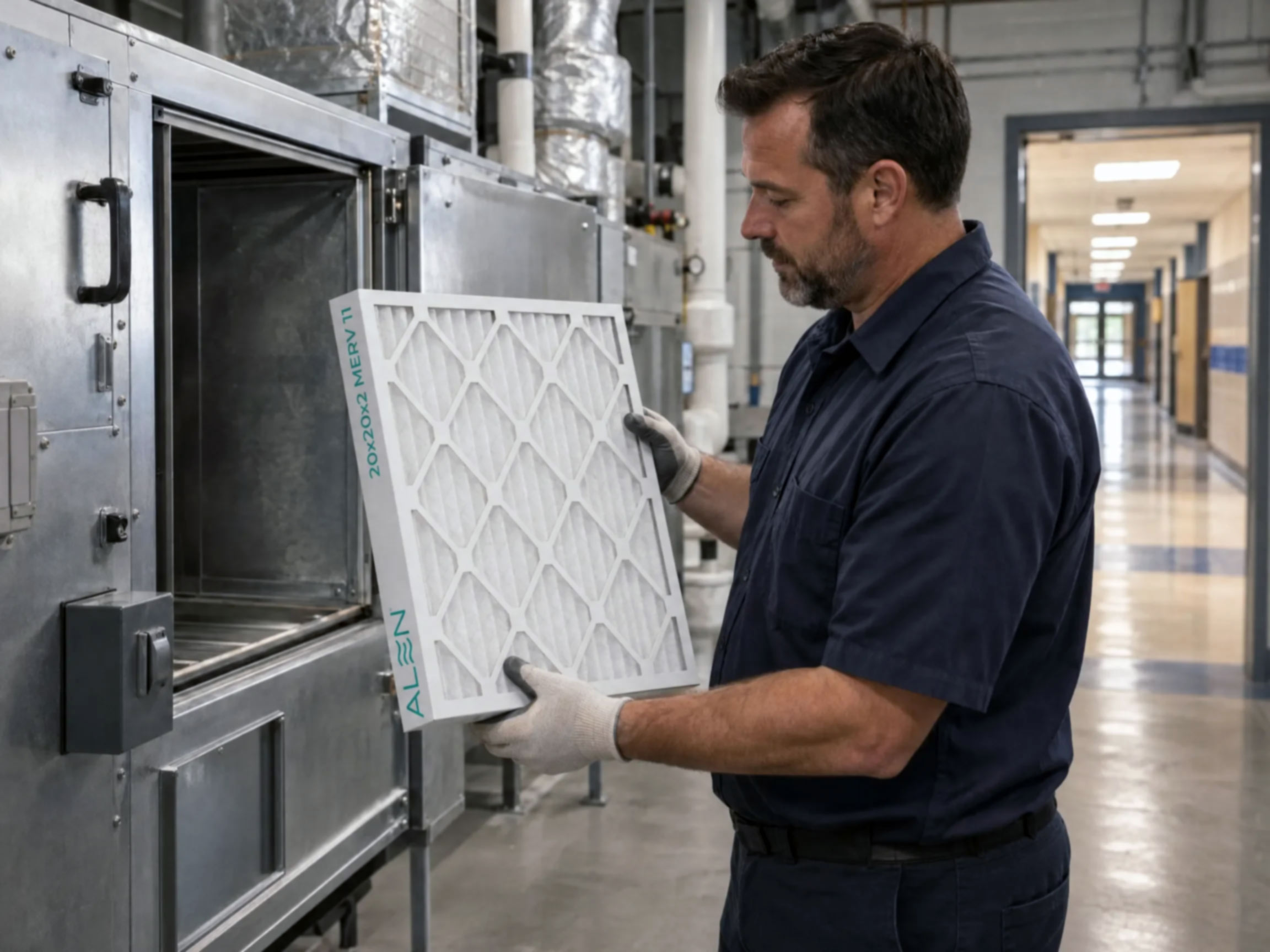
The High-Capacity Advantage: Why Filter Design Matters
Learn how high-capacity HVAC filter design can extend filter life, maintain airflow, and deliver long-term value for school districts. ...more
HVAC Articles
September 18, 2026•4 min read
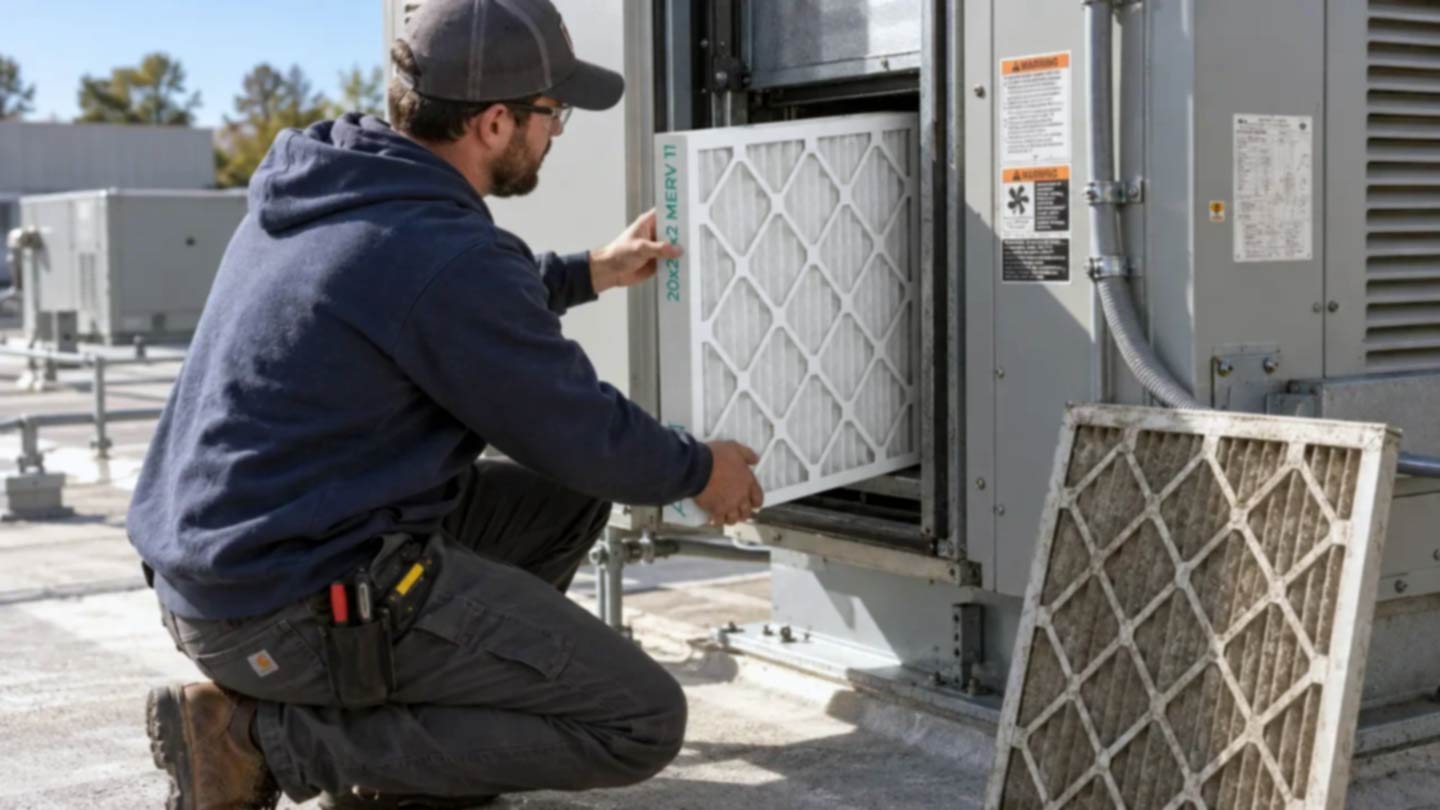
5 Ways High-Capacity Filters Can Save Your School District Money
See how high-capacity HVAC filters can help your school district reduce filter purchases, maintenance demands, inventory, and waste through longer service life. ...more
HVAC Articles
September 18, 2026•5 min read

Why Approved Vendors Still Create Problems For School Districts
Approved HVAC vendors do not always guarantee reliable delivery or consistent performance. Learn how school districts can prevent costly fulfillment issues by evaluating distributor stability, service... ...more
HVAC Articles
April 21, 2026•5 min read

Online & Phone Operating Hours
Mon to Fri: 8AM–5PM CST
The Program
About Us
Online & Phone Operating Hours
Mon to Fri: 8AM–5PM CST