
6 Steps to Build a Measurable Indoor Air Quality Strategy for Your School District
When you’re managing indoor air quality across 10, 30, or 50+ schools, it can be hard to keep track of everything. Every building has its own HVAC equipment, occupancy patterns, maintenance history, outdoor exposures, problem areas, and operating constraints.
One of your schools may struggle with outdoor pollen entering through busy doors, while another has an aging HVAC system that struggles to keep up with higher-efficiency filters.
Your district needs a system that helps you understand what is happening across all of your buildings, improve conditions using the infrastructure you already have, and prove that your strategy is actually working.
With Alen For Schools’ integrated IAQ strategy, a 30-school district could save an estimated $43,000 a year on filter purchases and maintenance labor, based on an illustrative district scenario. This approach helps transform isolated air quality improvements into a coordinated, district-wide program.
Start With a District Standard, Not a Collection of Solutions
One of the easiest ways for an IAQ program to become fragmented is to solve every problem independently. Each decision may make sense on its own, but together they do not necessarily create an air quality strategy.
A district-wide approach starts by defining what you want the program to accomplish across every building. This means establishing a consistent way to assess conditions, identify needs, take action, and evaluate results.
The EPA's IAQ Tools for Schools program takes a similar management-oriented approach. Its framework emphasizes organizing, assessing, planning, acting, communicating, and evaluating rather than treating indoor air quality as a single equipment decision.
Instead of starting with, ‘What should we buy?’ ask, ‘What do we need to know, improve, and demonstrate across our buildings?’
Step One: Establish Your Baseline
You can't improve what you haven't assessed. A practical district-wide indoor air quality (IAQ) strategy begins with understanding what's happening inside your buildings before making changes.
That means looking at more than your existing HVAC systems and filtration. You'll also want to evaluate airborne particle levels, ventilation indicators, temperature, humidity, outdoor air conditions, and how your classrooms are used throughout the day.
The EPA recommends building inventories, walkthroughs, assessments, preventive maintenance planning, and ongoing evaluation as part of an effective school IAQ program. Measurements such as temperature, relative humidity, airflow, and CO₂ can also help your facilities team better understand conditions across buildings.
So, what should your district include in its baseline assessment? Start with these six areas:
Baseline Component | What to Evaluate | What It Can Reveal |
|---|---|---|
1. Particulate matter (PM2.5) | Average particle readings, recurring spikes, and differences between classrooms | Which spaces experience higher fine-particle concentrations and when those increases occur |
2. Carbon dioxide (CO₂) | CO₂ levels during occupied hours, especially in crowded classrooms | Patterns that may indicate insufficient outdoor-air ventilation relative to occupancy |
3. Temperature and humidity | Temperature fluctuations, relative humidity levels, and persistent moisture concerns | Comfort issues and conditions that could contribute to moisture or mold problems |
4. Outdoor air conditions | Outdoor PM2.5, nearby traffic, wildfire smoke, and seasonal pollution | Whether increases in indoor particles coincide with outdoor pollution events |
5. HVAC and filtration performance | Filter MERV ratings, filter condition, replacement history, airflow, and pressure drop where available | Whether existing filtration or ventilation systems need closer evaluation |
6. Occupancy and building patterns | Class schedules, student density, HVAC operating hours, and recurring complaints | Whether air quality changes correspond with predictable activities or building-use patterns |
What Could a Baseline Assessment Reveal?
To see how this works in practice, imagine conducting an initial air quality assessment at one of your schools. The findings might look something like this:
Location | Baseline Finding | Recommended Next Step |
|---|---|---|
Math Classroom | CO₂ levels consistently rise during afternoon classes | Check outdoor-air ventilation rates and HVAC operating schedules |
East Wing | Recurring PM2.5 spikes during morning arrival | Investigate nearby entrances, bus activity, and filtration performance |
Library | Humidity remains elevated throughout the school day | Inspect potential moisture sources and evaluate HVAC dehumidification |
These examples are hypothetical and do not represent actual Alen customer measurements.
These findings help your facilities team identify where improvements are needed and prioritize resources across campuses. Rather than making building-wide changes based on assumptions, you can focus on the specific spaces and conditions that need attention.
And when you implement improvements, these initial readings become your benchmark for measuring whether those changes are working.
Step Two: Create Coverage Across Existing Buildings
Once you understand your starting point, the next question is how to establish consistent air quality protection throughout your district. For most districts, the existing HVAC system remains the foundation.
Central filtration works across the building, which makes it the logical place to create broad Coverage. The objective is not simply to select the highest MERV rating available. Filtration has to work with the equipment, airflow requirements, maintenance capabilities, and operating realities of each building.
Alen For Schools approaches this first layer through Alen High Capacity HVAC filters, creating a consistent foundation for building-wide air cleaning using the infrastructure your district already operates.
For your facilities team, this is where an IAQ strategy becomes scalable, as you improve the foundation across all your buildings.
Step Three: Add Precision Where It Matters Most
Building-wide filtration establishes a foundation for cleaner air throughout your school, but as you know, each school building is different. A classroom with 25 students is distinct from an administrative office. A cafeteria, music room, or meeting space will likely behave differently throughout the day.
That is where Precision becomes important. Room-level HEPA air purification allows you to strengthen air cleaning in spaces where occupancy, building conditions, outdoor exposures, or other factors create a greater need.
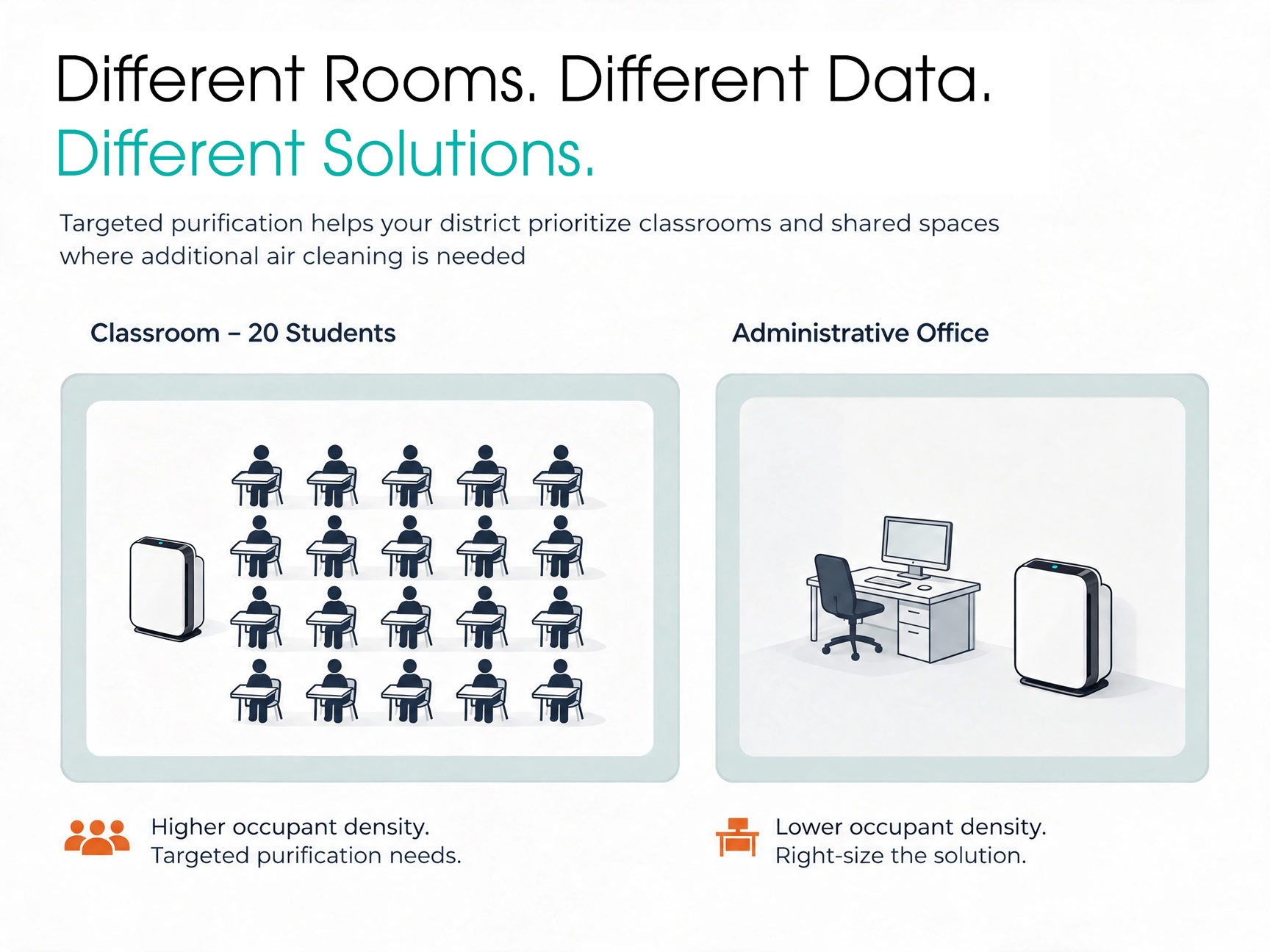
Targeted purification helps your district prioritize classrooms and shared spaces where additional air cleaning is needed most. That approach can also give you more flexibility in buildings where major HVAC modifications are impractical.
Central filtration continues doing the building-wide work, while portable purification strengthens specific environments without having to replace or extensively modify your existing HVAC equipment. The result is a layered system rather than a one-size-fits-all solution.
Step Four: Make the Invisible Visible with Ongoing Monitoring
Improving indoor air quality requires more than implementing the right solutions. You also need to understand whether those improvements are delivering measurable results.
Once you've identified problem areas and adjusted HVAC filtration or classroom air purifiers, ongoing air quality monitoring helps you evaluate their effectiveness. By continuously or strategically collecting data, your facilities team can track changes, identify recurring patterns, and determine where additional adjustments may be needed.
Alen's Proof platform uses connected air quality monitoring and smart sensors to track conditions over time, analyze trends based on building design and occupancy, and verify whether your interventions are improving indoor air quality.
This creates a continuous improvement cycle: Measure. Identify. Improve. Monitor.
With greater visibility into your buildings' air quality, your district can make informed decisions, optimize performance, and demonstrate the impact of your IAQ investments.
Step Five: Optimize Instead of React
Once you can identify patterns, your team can make more informed IAQ decisions. You can actually see when particulate levels increase in certain areas at predictable times, or when room-level purification resolves a recurring issue without requiring a new HVAC system.
Imagine knowing whether your IAQ strategy is delivering measurable improvements and where additional adjustments may be needed. This is where measurement begins to create operational value.
Instead of treating every classroom, filter, or building exactly the same, you can direct resources toward actual needs. This approach helps improve air quality while making better use of your maintenance team's time and your district's budget. After all, preventive management is better than waiting for problems to become costly or disruptive.
Step Six: Prove That Your Strategy Is Working
This is where your district can demonstrate the value of its air quality investments.
You should eventually be able to answer questions such as:
What were the conditions before we made changes?
Where did we identify the greatest needs?
What action did we take?
Did conditions improve?
Are those improvements being maintained?
Where should we focus next?
Those are operational questions, but they are also leadership questions. Superintendents, CFOs, risk teams, and school boards do not need every technical data point. But they do need confidence that your district has a process, that resources are being directed intelligently, and that performance can be demonstrated.
That is the role of Proof. Monitoring and reporting turn IAQ from something you say you’re managing into something you can show you’re managing.
For facilities teams, proof guides the next decision. For leadership, it creates accountability. And for boards and communities, it builds confidence that IAQ investments are part of a successful strategy.
What a Practical District IAQ Strategy Looks Like
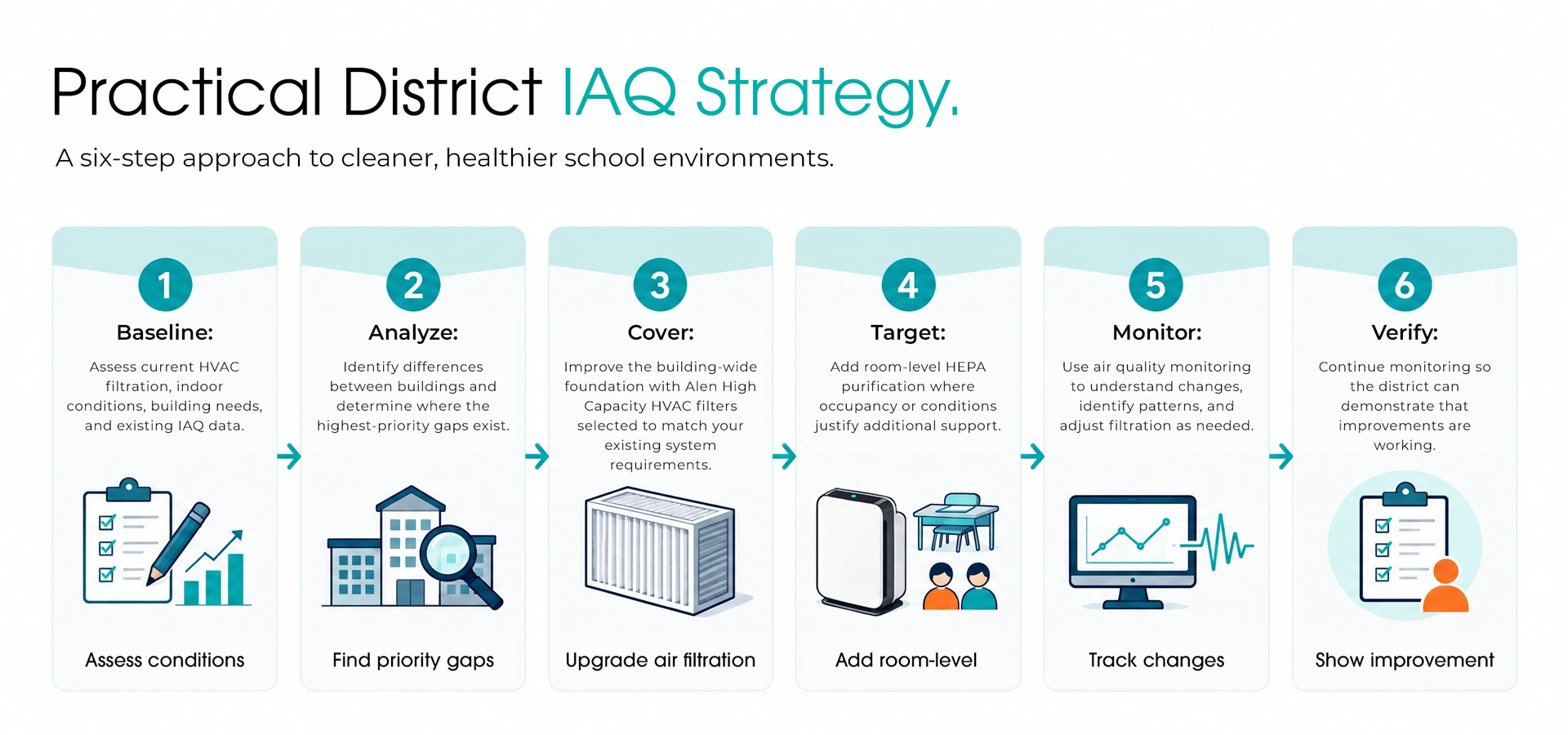
You don’t need to solve every building issue at once. You can start with this manageable framework:
Baseline: Assess current HVAC filtration, indoor conditions, building needs, and existing IAQ data.
Analyze: Identify differences between buildings and determine where the highest-priority gaps exist.
Cover: Improve the building-wide foundation with Alen High Capacity HVAC filters selected to match your existing system requirements.
Target: Add room-level HEPA purification where occupancy or conditions justify additional support.
Monitor: Use air quality monitoring to understand changes, identify patterns, and adjust filtration as needed.
Verify: Continue monitoring so the district can demonstrate that improvements are working.
While you may use different equipment depending on the school, your management process will stay the same.
From Air Quality Products to an Air Quality System
A filter supplier solves one part of the problem. An air purifier solves another. A monitor gives you information. But you need all of those elements to work together.
Alen For Schools is designed in three connected layers: Coverage through HVAC filtration, Precision through targeted room-level purification, and Proof through monitoring and verification. This integrated approach helps your district manage indoor air quality consistently across campuses while making smarter use of existing resources.
For a district of approximately 30 schools, switching to longer-life HVAC filters could save around $43,000 annually on filter purchases and maintenance labor, based on an illustrative district scenario. Actual savings depend on current operating conditions and maintenance practices.
That's the opportunity for your district: improve indoor air quality, make the most of your existing HVAC systems, and measure results while saving money.
Take Control of Air Quality Across Your District
Your school buildings will always be different. Occupancy changes. Outdoor conditions change. Equipment ages. Maintenance priorities shift. New challenges appear.
But a good IAQ strategy is built to respond to that reality. Your team should have the visibility and tools you need to make better decisions across your district.
Understand the baseline.
Create coverage.
Add precision.
Measure the result.
Keep optimizing.
Prove that it’s working.
That’s how indoor air quality becomes something your district can actively manage, rather than something you only address when there’s a problem.
Alen For Schools brings HVAC filtration, targeted air purification, and air quality monitoring together into one measurable district-wide system. Schedule an Alen district air quality analysis to see where your biggest opportunities for improvement may be.
